

San Joaquin College of Law offers a flexible program leading to the Juris Doctor degree. The degree can be attained in three, four, or five years. Attainment of the degree requires:
Completion of 86 semester units: 68 units of required courses and 18 units of electives, not more than four (4) of which may be clinical work. An additional four (4) units of clinical work may be completed in the New American Legal Clinic.
Required Courses for Graduation
| Course | Units |
| Advanced Research & Writing | 3 |
| Appellate Advocacy | 2 |
| Business Organizations I & II | 4 |
| Civil Procedure I & II | 5 |
| Community Property | 3 |
| Course | Units |
| Constitutional Law I & II | 6 |
| Contracts I & II | 6 |
| Criminal Law and Procedure | 6 |
| Evidence I & II | 6 |
| Legal Methods I & II | 4 |
| Course | Units |
| Moot Court | 2 |
| Professional Responsibility | 2 |
| Property I & II | 5 |
| Real Property Drafting | 1 |
| Remedies | 3 |
| Course | Units |
| Torts I & II | 5 |
| Wills & Trusts I & II | 5 |
Total Required Units: 68
Total Elective Units: 18
Total Units: 86
A cumulative grade point average of 65 or better at the end of spring semester. (Although transfer units from an ABA or state accredited law school may be accepted, only work completed at SJCL is credited toward a student’s cumulative GPA).
A minimum grade of 55 in all required courses.
Course attendance totaling a minimum of 16 semester units per academic year.
Completion of all graduation requirements within 5 years of initial enrollment, or 6 years from initial enrollment if the student was granted the right to repeat the first year, unless such limitation violates some state or federal, statutory or regulatory, provision.
Sample Fall Schedule for Evening Classes
| Monday | Tuesday | Wednesday | Thursday | |
|---|---|---|---|---|
| 6:30-9:30p | Torts | Civil Procedure | Contracts | Legal Methods |
Sample First Year Weekly Fall Schedule for Day Classes
| Monday | Tuesday | Wednesday | Thursday | |
|---|---|---|---|---|
| 11:00a-12:20p | Contracts | Civil Procedure | Contracts | Civil Procedure |
| 1:30-2:50p | Torts | Torts | ||
| 1:30-4:30p | Legal Methods |
* These sample schedules are subject to change.
Elective Units
The elective units required for graduation are obtained through elective courses offered primarily during the evening. Elective credit can also be earned via other academic activities, such as external Moot Court competitions, externship work, or the New American Legal Clinic. Study abroad classes offered by ABA accredited law schools or otherwise approved by the Faculty Committee also count for elective credit.
Four-Year Program
SJCL’s Four-Year Program is designed for a diverse community. The curriculum is intended to accommodate the needs of working students, parents, commuters, and others who have substantial commitments outside of their studies. The program requires an average of ten classroom hours each week throughout the four years. A student should expect to spend approximately two to three hours in preparation time for each hour of classroom time. The program is designed primarily as a night program, but there are some daytime sections of classes offered depending on demand and availability.
Sample Four Year Program
Year 1 – Fall/Spring (20 Units)
| Course Title | Units |
| Civil Procedure I & II | 5 |
| Contracts I & II | 6 |
| Legal Methods I & II | 4 |
| Torts I & II | 5 |
Year 2 – Summer (2 Units)
| Course Title | Units |
| Professional Responsibility | 2 |
Year 2 – Fall/Spring (20 Units)
| Course Title | Units |
| Business Organizations I & II | 4 |
| Criminal Law/Criminal Procedure | 6 |
| Appellate Advocacy (Fall) | 2 |
| Property I & II | 5 |
| Real Property Drafting | 1 |
| Moot Court (Spring) | 2 |
Year 3 – Summer (2 Units)
| Course Title | Units |
| Clinical and/or Electives | 2 |
Year 3 – Fall/Spring (21 Units)
| Course Title | Units |
| Constitutional Law I & II | 6 |
| Evidence I & II | 6 |
| Wills, Trusts, and Estate Planning I & II | 5 |
| Clinical and/or Electives | 4 |
Year 4 – Summer (4 Units)
| Course Title | Units |
| Clinical and/or Electives | 4 |
Year 4 – Fall/Spring (17 Units)
| Course Title | Units |
| Advanced Research & Writing | 3 |
| Community Property | 3 |
| Remedies | 3 |
| Clinical and/or Electives | 8 |
Three-Year Option
Students in the Four-Year Program who complete the first year with a minimum cumulative GPA of 75 can accelerate their studies by transferring to the Three-Year Option. Students who wish to transfer to the Three-Year Option are required to meet with the Director of Student Services, Academic Dean, Dean of Students, or Dean for approval before transferring. If receiving financial aid, the transferring student must also meet with the Director of Financial Aid. The Three-Year Option requires students to take additional courses during the second and third year of the program and complete a minimum of four (4) clinical units. Any outside employment in excess of (20) hours per week is prohibited.
Sample Three Year Option
Year 1 – Fall/Spring (20 Units)
| Course Title | Units |
| Civil Procedure I & II | 5 |
| Contracts I & II | 6 |
| Legal Methods I & II | 4 |
| Torts I & II | 5 |
Year 2 – Summer (6 Units)
| Course Title | Units |
| Professional Responsibility | 2 |
| Clinical and/or Electives | 4 |
Year 2 – Fall/Spring (26 Units)
| Course Title | Units |
| Business Organizations I & II | 4 |
| Criminal Law/Criminal Procedure | 6 |
| Evidence I & II | 6 |
| Appellate Advocacy (Fall) | 2 |
| Moot Court (Spring) | 2 |
| Property I & II | 5 |
| Real Property Drafting | 1 |
Year 3 – Summer (6 Units)
| Course Title | Units |
| Clinical and/or Electives | 6 |
Year 3 – Fall/Spring (28 Units)
| Course Title | Units |
| Advanced Research & Writing | 3 |
| Community Property | 3 |
| Constitutional Law I & II | 6 |
| Remedies | 3 |
| Wills, Trusts, and Estate Planning I & II | 5 |
| Clinical and/or Electives | 8 |
Five-Year Option
Students who must extend their education because of family, work, or other commitments can reduce the per semester course load and complete the program in five years. Students who wish to select this program must first seek authorization from the Director of Student Services, Academic Dean, Dean of Students, or Dean. The Juris Doctor degree must be completed within a total of five years from the time of admission.
SJCL Credit Hour Policy
One unit of credit for every course is provided for every one hour of direct faculty instruction in class per week through one 15-week semester. For example, a 3-unit course must meet for 3 hours per week. For every hour of direct faculty instruction in class, a minimum of two hours of out-of-class student work is expected. However, most students find that they must devote significantly more out-of-classroom time to their courses in order to be successful.
The Credit Hour Policy is reviewed to ensure compliance for all classes every two years. All new courses when reviewed and approved by the Curriculum Committee are reviewed for compliance with the Credit Hour Policy.
General Instructions for Completing the Application
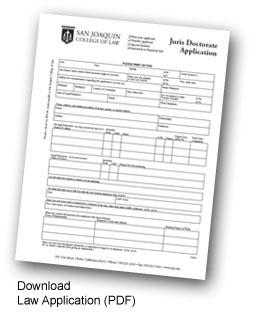 There are three methods for completing the application.
- The application can be accessed on our website and completed by entering information into the fields on your computer, print and mail to the San Joaquin College of Law Admissions Committee.
- Print the form using your computer, type or print legibly to complete the application and mail it in.
- Obtain a paper copy of the application from the law school and mail it in.
For the Application click here.
Mail the application with the $50.00 application Fee to:
Admission Committee
San Joaquin College of Law
901 5th Street, Clovis, Ca 93612
To get help completing the application contact:
Diane Steel
Director of Admissions
E-mail: dsteel@sjcl.edu
559-323-2100
San Joaquin College of Law has a rolling admission process, which means we have a limited number of seats and will admit qualified applicants as they apply. We are currently accepting applications for Fall. The deadline to submit applications for our Priority Review Early Application Program is March 31st. If an applicant fully completes his or her admission file by March 31st, and includes scores from the February LSAT or an earlier LSAT they will be given priority review. Applications with a June LSAT result submitted by the final June 30th deadline are considered if spaces remain available.
Submit application by March 31st
Priority Review Early Application deadline (Feb LSAT or earlier is required)
Submit application by June 30th
Final Review Application deadline (June LSAT is accepted)
Applications submitted after the June 30th deadline may receive consideration.
Several academic factors influence the admission decision: undergraduate grade point average (GPA), Law School Admission Test (LSAT) or Graduate Record Exam (GRE) score, a record of improvement in undergraduate study, graduate education, additional training, and continuing education. Honors, publications, and community service are also relevant.
SJCL attempts to discover students who show the capacity to succeed in law. The School’s broad policy includes consideration of community involvement, life experience, employment history and accomplishments, motivation, and maturity – factors which indicate the applicant will add a unique perspective to the student body.
The Law School prefers applicants who hold a bachelor’s degree or the equivalent from an accredited college or university. In some instances, particularly outstanding individuals without a four-year degree will be considered for admission, provided other requirements are met. (See Special Students.)
Preparation for Law School
Because strong analytical and communication skills are vital to the practice of law, students are urged to incorporate writing, logic, philosophy, and research courses into their pre-law curriculum. Please contact the Director of Admissions for additional guidance.
Pre-Admission Counseling
Interviews with the Director of Student Services, Dean, and other staff can be scheduled to explore admission criteria, procedures, finances, and career options. Also, meetings can be arranged with current students or faculty who can share insight into the rewards and demands of law school.
Application Deadline
The application deadline is June 30; however, it is to your advantage to apply early. The Law School operates on a “rolling” admissions process – that is, accepting qualified individuals as their applications are completed. Because there are a limited number of spaces, the class could fill prior to the deadline.
Admission Categories
Regular Students
Those holding a Bachelor’s degree in any major from an approved college of university qualify for admissions as a Regular Student. Under the rules of the California Committee of Bar Examiners, Regular Student status also may be achieved with 60 qualifying units of college credit.
Special Students
Exceptional applicants who do not have a baccalaureate degree, associate degree or 60 qualifying units of college credit are classified as Special Students. A limited number of Special Students are accepted each year.
When reviewing Special Student applications, the Admissions Committee stresses a solid LSAT or GRE score (50th percentile or better), a GPA of 3.0, or above, on any college coursework completed, maturity, and a record of personal accomplishment.
All Special Students must take three College Level Examination Program (CLEP) tests. Pursuant to Committee of Bar Examiners’ rules, an applicant must take the English Composition or English Composition with Essay and two other examinations, each designed to correspond to full-year courses (6 semester hours each) or four other examinations, each designed to correspond to semester courses (3 semester hours each) that can be selected from any of the following subjects: composition and litereature (Humanities examination only), foreign language, history and social sciences, science and mathematics, or business.
Upon completion of their first year, “Special Students” must successfully pass the First-Year Law Student’s Examination administered by the Committee of Bar Examiners in order to proceed.
Transfer Students
Students who are in good standing at either a state-accredited or ABA-accredited law school and are applying for admission with advanced standing are considered Transfer Students. Transfer Students are required to submit official transcripts for all law school work and a letter of good standing from the dean of the law school previously attended. Credit for specific course requirements is established on an individual basis. SJCL maintains a written record of a Transfer Student’s previous education which indicates the credit that has been granted and what work the Transfer Student must complete at SJCL to attain the degree.
Application Procedures
All applicants are required to take the Law School Admission Test (LSAT) or the Graduate Record Examination (GRE) and register with Credential Assembly Council (CAS). LSAT registration is available at www.lsac.org. GRE registration is available at www.ets.org. Other application procedures are completed through SJCL or online at www.sjcl.edu.
Law School Admission Test (LSAT)
The LSAT is a standardized test of reading comprehension, writing ability, and analytical skills. It is given six times annually at testing centers throughout the United States.
The LSAT may be taken more than once. LSAT scores are valid for five (5) years.
A sample LSAT test is available at lsac.org. Additional sample tests are available for a fee on-line at www.lsac.org. There are preparation books available at most large bookstores. There are also preparation courses that the applicant may wish to explore.
Graduate Record Examination (GRE)
The GRE measures verbal reasoning, quantitative reasoning, critical thinking, and analytical writing skills. The GRE may be taken more than once. GRE scores are valid for five (5) years.
Credential Assembly Service (CAS)
All applicants must register with CAS. The Law School Admission Council provides a uniform analysis of applicant biographical and academic information to law schools.
CAS requires official transcripts sent directly from each college or university attended. Official transcripts must also be sent to CAS directly from all colleges and universities attended whether or not a degree was received. It is advisable to register with CAS as early as possible to allow time for mailing and processing of transcripts.
Once SJCL receives your application we will contact CAS to order your report. When your CAS file is complete and without financial holds, your report will be sent to SJCL. If you reapply to SJCL in a subsequent admission year, you will need to purchase a new report.
For more information about CAS, visit their website at www.lsac.org or call 215/968-1001.
Transcripts
Official transcripts must be sent directly from each institution attended to LSAC for the CAS report. Additionally, an official transcript must be submitted to SJCL from your degree granting institution.
Your Personal Statement
A personal statement is required from all applicants. The statement serves as an example of your ability to express yourself clearly and concisely – skills essential to the practice of law. Your statement should focus on: why you have chosen to study law, why you believe you will be successful in your studies and in the legal profession. Your statement is your opportunity to call attention to particular areas of your background, such as work experience or community activities.
Letters of Recommendation
Applicants to SJCL are required to submit two letters of recommendation. Letters should come from individuals who know you well, excluding family members. These individuals should be able to describe your academic qualifications, analytical ability, communication skills, character and/or accomplishments. Special emphasis is given to letters from persons who have taught or worked with the applicant.
Download the law catalog (PDF)
Individual Attention
At SJCL, the study of law is an intense endeavor, but the skills and doctrines learned will benefit you professionally on a daily basis. Our small class sizes allow students to receive individual attention from faculty. At SJCL, the competition is against oneself and high professional standards – not other students.
Attendance Method
SJCL offers two attendance methods for its Juris Doctor program: the in-person program and the remote option (distance learning) program. Before the start of each semester, students are required to choose to attend classes in one of the methods. For more information, please visit: www.sjcl.edu/onlinejd.
Facilities & Location
SJCL occupies a Mediterranean Renaissance building in a park-like setting in downtown Clovis. The facility consists of seven classrooms, courtroom, library including group and individual study spaces, the New American Legal Clinic, student organizations offices, student lounge, and faculty and staff offices.
Learning Outcomes
The Juris Doctor program at San Joaquin College of Law seeks to create a program of legal education which produces graduates who are highly skilled individuals who can contribute to the development of legal and social institutions and to the integrity of the legal system. To this end, the Faculty has formally adopted a set of measurable Student Learning Outcomes (SLOs) which all courses, collectively, are designed to meet. Each professor will articulate in the course syllabus those specific SLOs taught and assessed in the particular course.
Outcomes
- Demonstrate comprehension of the structures and processes of the U.S. legal system and foundational substantive law.
- Demonstrate proficiency in legal analysis and problem solving.
- Demonstrate competence in written and oral communication.
- Demonstrate mastery of appropriate strategies and technologies to legal research.
- Recognize and resolve ethical issues.
Student attainment of the SLOs will be reflected not only in the grades students receive in their individual courses, but may also be separately assessed from time to time by mechanisms independent of individual course assignments and examinations.
Accreditation
San Joaquin College of Law is accredited by the Committee of Bar Examiners of the State Bar of California, permitting SJCL graduates to sit for the California Bar Exam, as well as by the Accrediting Commission for Senior Colleges and Universities of the Western Association of Schools and Colleges, an institutional accrediting body recognized by the Council for Higher Education Accreditation and the U.S. Department of Education. SJCL is accredited by the Committee of Bar Examiners of the State Bar of California, giving SJCL its degree-granting authority and qualifying SJCL graduates to take the California Bar Exam and obtain admission to the practice of law in California.
WASC Senior College and University Commission
1080 Marina Village Pkwy, Suite 500, Alameda, CA 94501
(510) 748-9001
www.wscuc.org
Committee of Bar Examiners, The State Bar of California
180 Howard St., San Francisco, CA 94105
(415) 538-2000
www.calbar.ca.gov
For Consumer Complaints
An individual may contact the Bureau for Private Postsecondary Education for review of a complaint. The bureau may be contacted at:
Bureau for Private Postsecondary Education
P.O. Box 980818, West Sacramento, CA 95798-0818
(888) 370-7589
www.bppe.ca.gov
A Unique Student Body
SJCL students don’t fit a particular mold. They are simply motivated and ready to learn. Our students represent a variety of ages, background, and experience. If you’re seeking a legal career, looking for a change of pace, or wanting to enhance your professional skills – SJCL is for you. Our student body reflects SJCL’s progressive and diverse environment.
Abundant Careers
The SJCL course of study combines theoretical knowledge with practical skills. Our clinical opportunities place students in a variety of legal settings, providing students with a stimulating job experience and professional contacts to facilitate a natural transition into the legal field. Most SJCL graduates find employment locally, while some venture into California’s most competitive markets. As SJCL is the only law school in the Central Valley our students benefit from the multitude of internships, clerkships and career options without the competition.
Ensuring Success
The staff at SJCL understands that many students have responsibilities that extend beyond law school. Every effort is made to facilitate each student’s personal academic success. Dedicated faculty members regularly hold study and review sessions. Students are encouraged to organize study groups – building camaraderie that translates into professional contacts after graduation.