


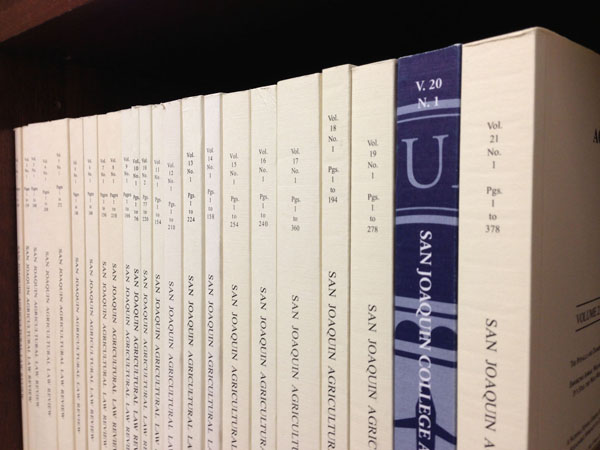
This synopsis of a recent student comment featured in the San Joaquin Agricultural Law Review Volume 28 is part of an ongoing series for Fresno County Bar Association’s Bar Bulletin. The San Joaquin Agricultural Law Review, founded in 1991, is the nation’s first agricultural law review. The San Joaquin Agricultural Law Review is published annually by students of San Joaquin College of Law and is comprised of works from students and professionals from all over the nation. The past 27 Volumes have served as a medium for those most passionate about current legal issues stemming from agriculture’s relationship with the economic and governmental infrastructures of the United States. Authors of articles and comments have been cited by courts of the highest honor, such as the United States District Court for the Eastern District of California, the United States District Court for the Middle District of Tennessee, the California Supreme Court, the Minnesota Supreme Court, the Court of Appeal for the Fifth District of California and the New Mexico Court of Appeals among others. The previous Volumes are available on line at www.sjcl.edu/law-review. Professional articles are always welcome. Contact Volume 29 SJALR Executive Editor/Community Liaison Editor Danielle Patch at danielle.patch@student.sjcl.edu for more information.
What You See is What You Guest: Is H.R. 6417 Unconstitutional?
By August Wolf Petersen J.D. Candidate
28 San Joaquin Agric. L. Rev. 1 (2019)
San Joaquin Agricultural Law Review
H.R. 6417, introduced by North Carolina Representative Bob Goodlatte on July 11, 2018, also known as the Goodlatte Bill, or the Agriculture Guestworker and Legal Workforce Act, aims to accomplish twin goals: to update the present temporary visa regime for agricultural laborers who are foreign nationals and to make mandatory employers’ participation in E-Verify, a pilot program since 1996 creating an electronic database for purposes of to I-9 work authorization.
This comment accounts the historic relationship of immigration law and California agriculture, particularly emphasizing the Immigration Reform and Control Act of 1986 and provisions connected to amnesty for persons who are undocumented in the United States. Against this historical background, the comment presents a close reading of provisions from H.R. 6417 which would include the creation of a first-in-time right for state and local law enforcement officers in tandem with federal law enforcement agencies to investigate documentation violations and collect resulting fines.
As opposed to such drastic and invasive measures, this comment ultimately suggests that Congress should undertake a better policy connected to authorizing the workforce, e.g., to grant amnesty to undocumented persons, or in the alternative to subsidize U.S. worker employment.
In addition, this comment outlines a legal standard from constitutional law jurisprudence circumscribing the fundamental right to pursue a common calling. Also, this comment undertakes to examine in the abstract whether the right of common calling may be protected against disparate treatment effected by the federal government. Finding a case for constitutional protection of the right of common calling, this comment then discusses whether farming is cognizable as a common calling and remarks House Bill 6417’s likely effects including labor shortage and unfair competition.