

By Shannon Wentworth, BREN Clinic Director
Laura Higareda-Chapa is no stranger to advocacy. As a former Congressional staffer for Congressman Cal Dooley and District Director for U.S. Senator Dianne Feinstein from 1993 to 2001, Higareda-Chapa has been turning her advocacy into action.
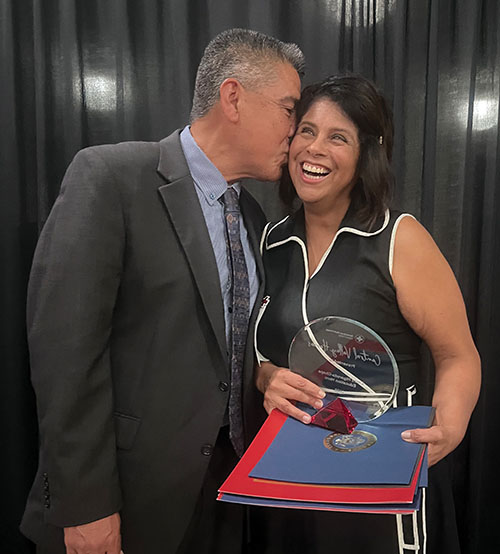
The Red Cross honored her work as the first education attorney in the Juvenile Unit of the Fresno County Public Defender’s Office with a Central Valley Hero Award for Education for advocating for students “pushed out of classrooms when they need support the most.”
Higareda-Chapa knows firsthand that the justice system can become a revolving door for juveniles as they mature because her brother has been caught in that cycle since he was a child. It was that desire to advocate for youth that brought her to San Joaquin College of Law.
Higareda-Chapa grew up in Porterville and earned a Bachelor of Arts degree in philosophy from UC Santa Cruz before marrying her best friend and husband of 28 years Tim Chapa with whom she has 3 children (23, 24, and 27). She shifted gears from stay-at-home mom to full-time law student in 2018. She was drawn to SJCL because of its high Bar passage rate for women.
She appreciates that SJCL encouraged the exploration of different areas of practice. She arrived certain that she would pursue criminal law. However, she took advantage of the opportunity to explore other areas, finding Professor Jodie Howard’s nascent special education law class. Now, she works in the Fresno Public Defender’s office at the intersection of criminal and special education law.
“My experience in special education law with Professor Howard sparked a particular interest,” she said. “Learning about the significant discrimination students with disabilities faced in the past – and how federal legislation has improved conditions – was eye-opening. Despite the progress many students with disabilities continue to encounter challenges in schools today, but the law provides meaningful ways to advocate and support them.”
She honed her skills working as a law clerk in SJCL’s BREN Special Education Legal Clinic, where she discovered, “Education is not just a privilege, but a right worth defending.”
She notes that the intersection of special needs and criminal law is backed by U.S. Bureau of Justice Statistics’ 2016 study that showed 24 percent of inmates nationally participated in special education classes. “This statistic underscored for me how critical early advocacy for students with disabilities can be,” Higareda-Chapa said. “Personally, as I reflected on my own brother’s experience with the criminal justice system, I could not help but wonder whether he, too, struggled with undiagnosed learning disabilities following the traumatic brain injury he sustained at age six. This realization has made my work feel more meaningful than ever.”
The intersection of education and criminal justice does not end with special education advocacy; it also encompasses the defense against exclusionary discipline. Zero-tolerance for violence policies in the wake of 1996-1997 school shootings were adopted by roughly 79 percent of schools, according to the Vera Institute. “A generation later, statistics consistently show these policies have not made schools safer,” she said. “They have only succeeded in increasing exclusion and disengagement. Further, these policies disproportionately impact already marginalized students.”
The Fresno County Public Defender’s office has long understood this connection, culminating in the hiring of Higareda-Chapa as the office’s first education attorney. “Our goal is to collaborate with schools to keep students engaged, supported, and safe through tailored solutions that prevent exclusionary discipline and address each student’s unique needs,” she said.
Having an education attorney at the Public Defender’s Office is fairly novel in California, with only a few other counties in the state employing them. To date, Higareda-Chapa has directly and indirectly assisted roughly 100 students during her tenure on everything from expulsions to qualifying for services. She also advises parents on IEP / 504 advocacy.
“The objective is to get more schools to consider alternative means of correction in lieu of exclusionary discipline, consistent with the State’s legislative intent underlying the Education Code governing student discipline,” she added. “This will help ensure students receive timely, appropriate support and rehabilitation that keeps them engaged in school, on track academically, and on a path toward success.”
“I am honored to fill this position and to continue to collaborate with the schools to ensure every youth has an opportunity to obtain an education and future success,” she said. “I want to continue to build this program, add more education attorneys, support other youth defenders, and increase representation in schools.”