

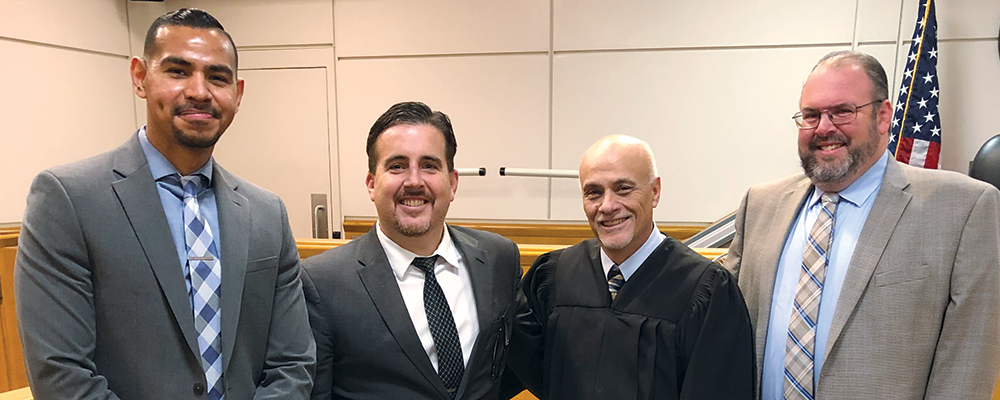
(L-R) Diego Andrade (Law ’16), Jordan Brown (Law ’16), Honorable Hugo Loza, Presiding Judge of the dependency courts for Tulare County Superior Court, and Tim Bragg (Law ’11).
On any given day in this country, a lot of media attention is given to legal issues facing criminals, huge corporations, celebrities, and lost souls. It is rare, however, for the tribulations of the misguided, everyday folks who wind up in dependency court to receive any notice.
For three SJCL alumni, the role of dependency court advocate is hugely significant, for it is there that struggling families have the potential to be saved.
Diego Andrade (Law ’16), says he always intended to become a law enforcement officer. As a young man who grew up in Tulare County, he became a father at 19 (during his first year of college), and ultimately attained a degree in Criminology from Fresno State. Upon learning there was a law school he could attend locally, his interest switched from law enforcement to advocacy, and he enrolled in SJCL.
“I took the risk,” he said during a recent lunch with his fellow grads-turned colleagues. “I knew it would be tough, but I had faith in myself. I knew if I put the work in and I could figure it out and adapt, that I could do it.”
Diego continued working at various jobs (including pizza delivery driver) throughout law school, but he says his position representing parents in dependency court has made it all worthwhile. “This area of law is emotional and intimate. You are intruding into people’s lives. Children are being removed from their parent’s custody.”
Diego says the best part of his job is when, after the ups and downs of a case, the parent is successful, and the child is returned to their custody. He described the feeling as “a round of applause moment” because the parent did all they needed to do to get their lives back on track. There are often mental health issues, or substance abuse, or unhealthy relationships, but when the parent is able to resolve their issues and become a functioning member of society it’s very rewarding, he said.
“That’s when it feels like we have really helped the family, and ultimately the community overall,” he added.
Jordan Brown, Law ’16 agreed. “You are dealing with people at their utmost worst. Their kids have been taken away, there is probably not a worse time in their life, and you are trying to explain their legal options.”
Jordan, who formed a study group with Diego during law school and now counts him among his colleagues on the team of dependency court attorneys contracted with The Allen Law Firm in Visalia, says the job touches on differing areas of the law.
“Parenthood is a fundamental right, protected by the constitution just like our liberty. We have family law issues, and sometimes criminal law issues, so we deal with a lot.” Jordan said much of the time they provide their parent clients with common sense encouragement, almost like a life coach. “You have to have a heart for people,” he added.
Jordan was a business owner/entrepreneur for 14 years before starting law school. He and his wife owned a coffee roasting business which he says was “super fun” but didn’t predict a great deal of longevity. Jordan says his business experiences piqued his interest in law. Although not a stellar student during his undergrad years, Jordan says he felt his interest in law could help him make it through law school. He continued to work his coffee business throughout and was able to push himself from the rank of next to last in his class to the top 17 by the time he graduated.
Tim Bragg (Law ’11) said that only about half the advice he and his colleagues give their clients is legal advice. The other half is more “life-skills” guidance he said. “We tell them they need to get it together. We use our own life experiences and roles as parents to empathize with their challenges, sort of like holding their hand (as they navigate their way toward success).”
Tim, who spent some 14 years as a journalist before enrolling in law school, says he wanted his 2nd career to be stable and long-lived. The blows from the economy and the growth of digital media has steadily choked the newspaper industry, leading to bureau closures across the country.
Tim says he enjoys being his own boss. He says it’s great to have the stable income of the contract with the dependency court, in addition to retention of his own schedule and work/life balance. Each of the three graduates have their own solo practitioner law offices, where they are free to take on additional cases if they wish.
Diego agrees with the ease of schedule, noting that he is able to adjust to accommodate his wife’s turn to earn her teaching credential. “The flexibility of this job is ideal for my family,” he said.
Diego says his role in dependency court reflects his ultimate definition of the attorney’s mission – to help fellow community members to improve the quality of their lives.
All three of the alumni agreed that the victories are not as plentiful as the fails among the parents they work with, but they say they never stop looking for little bits of hope.
“It’s really tough when you have to tell them their parental rights are being terminated and there is nothing more we can do for them,” Jordan said. He added that dependency court is collaborative in nature. The collaboration among the various constituents is there to assist the family wholistically. “The question is, can we get these parents the help they need to put this family back together.”
Ultimately it is a belief in social justice that keeps the dependency counselors upbeat and motivated. Their ultimate goal is to ensure that everyone gets the opportunity to correct their wrongs. “Many don’t make it, but we help to give them the opportunity for a do-over, and that is what’s most rewarding,” said Tim.