

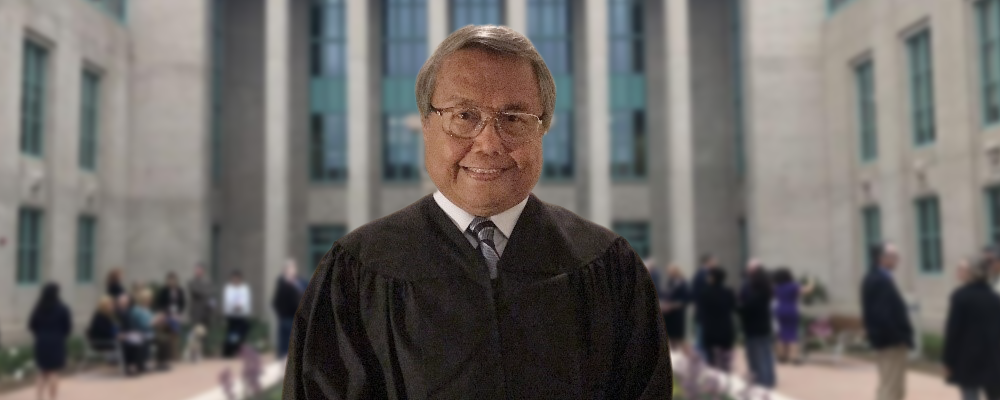
Amidst a pandemic, and with two years remaining in my term, I advanced my retirement from the Monterey County Superior Court from July to May of this year. At age 70, the sedentary nature of the job had taken its toll: I have had one back surgery and two special procedures during the last three years. The coronavirus provided the final nudge for me to leave the bench which I had occupied for only 13 years with nary a chance to say thank you and goodbye. I have no regrets. Hunkered down, I have had a chance to reflect on life, and my journey to the bench.
Coming to America
Throughout our lives, we all have faced situations where we have had to make life—changing decisions. In my case, and, making light of things a bit–I made one such decision in 1971: I came to a fork in the road, and took it, as Yogi Berra once advised. I was in my third year of college in the Philippines in 1971 when the political situation under the Marcos government became dire and outright dangerous as violent street rallies and demonstrations ruled the day. As the editor-in-chief of the university paper, I worked mostly behind the lines, writing articles and columns critical of the regime. In one of those columns, I made what at the time was a risky call: “We need a revolution.”
Friends of mine, particularly a family which hosted me when I was an exchange student at Reedley High School three years earlier, had been imploring me to get out of the country while it was still safe to do so. With their help, and with only one year remaining to get my bachelor’s degree, I opted to drop out of college and come to the United States on a student visa in September 1971. Had I waited one more year, I would have been unable to leave. Almost a year to the day of my departure, Marcos declared martial law and suspended the writ of habeas corpus; scores of the leaders of the militant movement were arrested and many of them were killed.
Formulating a Life Plan
Arriving in America, I formulated a life plan: maintain my student visa and prolong my studies toward a college degree so I could wait out what was then perceived to be the imminent overthrow of the Marcos regime. Thereafter, I was to go back, enter politics, and eventually become the President of a fair and democratic Republic of the Philippines. A tad ambitious, I must say, but in those days, raw idealism was in full flower.
But fate intervened. After just a semester at Reedley College and two quarters at Pacific College, I was given credits for my college courses in the Philippines and handed my diploma. Graduating from Pacific College in 1972, I was faced with yet another difficult decision: how to maintain my student visa, having already completed my college degree.
Ending Up in Law School
Enter three major stalwarts of this school: the late Judge Dean Eymann, and prominent attorneys John Loomis, and Oliver Wanger (now a retired federal judge). Their vision of establishing a law school (on the Pacific College campus at that!) provided me with a lifeline. Just before graduation, I saw a flyer on the Pacific College student bulletin advertising enrollment being open for the upcoming fourth school year at San Joaquin College of Law. I enrolled, and thus ensured myself of another four-year extension of my student visa.
Up until that time, the thought of becoming a lawyer was furthest from my mind. Having been deeply involved in campus journalism in high school and in college, I had fancied myself obtaining a degree in journalism and traveling every nook and cranny of the world covering wars, revolutions, and other earth-shattering events. As fate intervened, my career path was directed to the law profession, not by choice, but by luck and circumstance.
In law school, I had the good fortune of having been a part of a study group that included the likes of Gary Austin who went on to become a judge, and Charles Brewer—a Navy jet pilot who, if not for an injury suffered during the Vietnam War, would have been in the astronaut corps. Brilliant students. We pushed one another to study hard. Slack off and you are banished from the study group. As the law school was not state accredited then, we all had to take and pass the so-called baby bar exam in order to move on to the second year. Flunk the exam, and my student visa would not have been extended and I would have had to return to the Philippines.
Passing the Bar Exam
I completed law school in 1976 and passed the bar exam on my first try. Fifteen out of 16 in my class passed, with the sixteenth making it on his second attempt. At this juncture, I must point out—if only to emphasize my gratitude and a further fateful connection to SJCL—that I had another good fortune of being able to review for the exam all by myself at Tom Campagne’s house. Tom graduated from SJCL and passed the exam a year before me and had obtained a job with a law firm in San Francisco. He was so gracious to lend me his entire house for my bar review that summer while he started a job in San Francisco. So, I hunkered down in much the same way I’m doing now under the State’s shelter-in-place order, and, with possibly the same, if not greater, amount of fear.
Starting a Legal Career
I started my legal career as a criminal defense attorney with the law firm of Gendron & Gendron (now defunct) in Madera. While there, among other things, I did legwork for the more senior attorneys in the firm in the defense of one of the defendants in the Chowchilla school bus kidnapping case. Three years thereafter, and wanting a taste of civil law, I landed a job as a deputy county counsel in Imperial County and worked there for four years.
In 1983, having been offered a job as a deputy county counsel with the Monterey County Counsel’s Office, I pulled up stakes and moved to Monterey County with my wife and a two-year old son. Subsequently, I headed the office’s land use division, supervised four attorneys, and handled land use and environmental law litigation at the trial and appellate court levels. A couple of my cases under the California Environmental Quality Act (CEQA) resulted in published decisions.
The beginning of the 1980’s saw the Marcos regime still clinging to power, albeit precariously. By this time, all thoughts of ever going back to the Philippines had long vanished as I had started a family and put down roots in my adopted country. Ironically, I took my oath as a U.S. citizen on February 14, 1986—11 days before Marcos was ousted from power during the People Power Revolution. In the meantime, my wife and I had our second child—who would go on to follow in my footsteps and eventually become a California lawyer. One of the proudest moments of my career occurred when I administered the attorney’s oath to her in my courtroom.
Becoming a Judge
I became a lawyer and, subsequently, a judge, not because I dreamed of becoming one but partly because of luck, fortuitous circumstances, and fateful decisions I had made. This may disappoint those idealistic types expecting to hear some noble or profound reason for my choice of this profession or career path. But, as Shakespeare admonishes, “to thine own self be true.”
Content and professionally satisfied with my supervisory functions as well as my trial and appellate work with the Monterey County Counsel’s Office, I never considered a career on the bench until clients and colleagues urged me to apply for one of three vacancies on the Monterey County Superior Court. Spurred on by their encouragement, I applied. And so, it came to pass that in 2007, a late bloomer at age 57—I found myself on the bench, having been appointed to the third vacancy on the court by Governor Arnold Schwarzenegger.
My assignments on the Monterey County Superior Court included service in criminal court in Salinas and in King City (until its closure in 2013) as well as in civil court in Monterey. Twice I ran uncontested for re-election to a six-year term. I also served as a member and, later, chair of the board of trustees of the Monterey College of Law. The law school was established at about the same time that SJCL got started.
Limitations of Judicial Power
As a judge—and mindful of the enormous power that judges hold as well as having lived under the abuses of an autocratic regime in the Philippines—I always reminded myself of the limitations and careful exercise of judicial power. I did so especially when dealing with self-represented litigants and those traditionally underserved and often neglected segments of society. I always aimed to be sensitive to the perceived inequities in our society and strove to perform my duties so as to, in my own small way, achieve fairness and impartiality in my court. Poignantly, I remember being once disqualified in a case by a city prosecutor, presumably after I got a little carried away and pontificated on the criminalization of homelessness. But I have no regrets. I say what I mean and mean what I say, to borrow a popular expression.
Grateful for the Opportunities
As I leave the bench, I will be eternally grateful for the opportunities that have been afforded to me and my family in this country. I am most proud to have raised a service-oriented family of two registered nurses (my wife and a son), a daughter who recently became a lawyer and now works for a federal agency in Washington D.C. and whose husband is serving in the US military, and another daughter with a Masters’ Degree in social work employed as a social worker for a mental health facility in Orange County.
While on the bench, I always reminded myself of all the blessings of living in a country such as ours. Upon my suggestion, my bailiff would announce the opening of the court’s session each day thus: “In honor of the flag of the United States of America, the Superior Court of California, County of Monterey, is now in session.” In my letter informing the presiding judge of my intent to retire, I wrote: “When I dropped out of college during those tumultuous years in the Philippines in 1971 and came to the United States on a student visa, little did I know that I would be able to complete college and law school, become a lawyer and a judge, and raise a family in the process. This country has made it all possible for me to do so, and, trite as it may sound, live the American Dream.”My retirement plans? When friends and colleagues ask me about it, I tell them it’s encompassed in the acronym, MTTV: Music (I play an electric guitar in gigs with a rock band), Travel, Tennis, and Volunteering. Thus, the journey and the dream continue.