

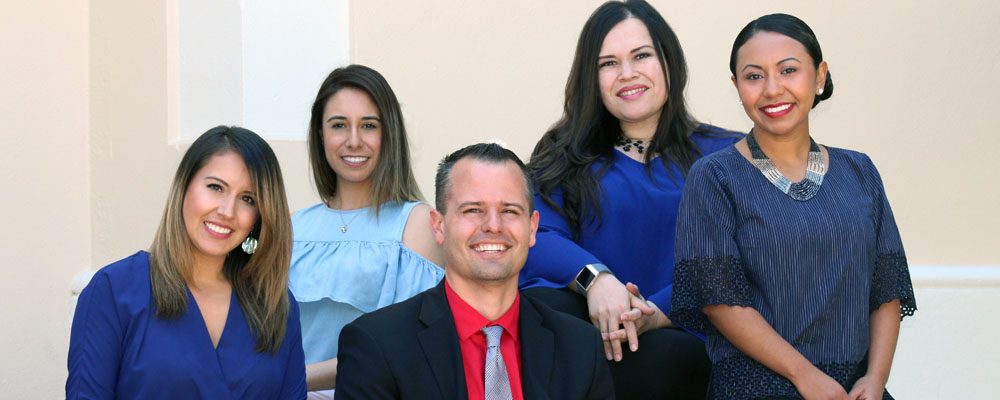
Meet Gregory “Goyo” Olson, Director for SJCL’s New American Legal Clinic and Real Property Professor at SJCL. As a former civil litigator, he appreciates how rewarding the work he does now is. Learn more about Gregory, why he drives home with a smile on his face every day and how the New American Legal Clinic gives potential future citizens hope despite today’s political climate.
What is the New American Legal Clinic (NALC)?
Our Academic Dean, Justin Atkinson, started NALC in 2012 because he saw a need for quality immigration help for low-income people in the Central Valley. He also felt that we needed to offer students a clinic where they could do work for clients and learn in that type of setting. We have grown to the point that we currently process about 110 naturalization applications every quarter, so we’re helping people on a constant basis and we don’t charge any fees for our services. Our main focus is helping our students learn more about immigration law and how to best represent their clients. We currently have five staff members and there’s also a steady ebb and flow of students and cases for us to maintain, so our staff is able to keep things running smoothly even when students are on break or during finals.
Why and how was the New American Legal Clinic started?
Before the clinic started, there was some discussion during the Obama administration about the possibility of immigration reform. So the idea was that if we could get our students trained in what immigration law is, they would have a head start if immigration reform happened but it didn’t. What happened instead as a result of that was the start of the Deferred Action for Childhood Arrivals (DACA) program, which made it so that immigration was even more on the forefront of people’s minds. Now as all this stuff is currently happening with the Trump administration, DACA and the Dreamers, we already have a program in place that functions very well and is an asset for our students because it’s here to serve them.
What services does the New American Legal Clinic offer?
The biggest thing we do is naturalization, which is helping legal permanent residents become citizens and that’s the bulk of our grant work and the work the NALC staff does. People will come into the office, we’ll screen them to see if they’re eligible and if they are, our staff fills out an application for them. I review it for accuracy to make sure there are no trouble spots or issues that we need to investigate further. We then send off the application and once our client’s appointment comes up with United States Citizenship and Immigration Services (USCIS), then an attorney will go with our client to make sure their case goes smoothly, whenever possible. Most of the time cases do go smoothly, but it helps to have an attorney present to ensure their rights are respected and they’re properly represented.
We also process U-Visas, which help clients who are undocumented and are the victims of violent crimes, including domestic violence, rape and assault victims. If they help the police and fully assist in the investigation of a crime, they can receive certification from the police proving they were helpful. We can then use that certification to apply for the U-Visa, which gives them some legal status here in the U.S. After four years of having a U-Visa, they’re able to become legal permanent residents and be on the path to citizenship. We also have asylum cases that we process for people who are fleeing persecution from their home country.
How long is the process of obtaining a U.S. citizenship?
If they’re already a resident, we’ll apply and usually within six months they will have their interview and within a month after their interview, they’ll have their oath ceremony. So it’s anywhere from six to eight months from that point in the process. For the other people that we’re helping that don’t have a legal permanent residence yet, it’s a matter of receiving initial status, such as a U-Visa, which can take more than three years to obtain for example. Then it would be another four years before they get their legal permanent residence and then they’d have to wait another five years before they can apply for citizenship. So in total, it ends up being about 12 to 13 years before they’d have that first chance to be able to apply for citizenship. Quite often, because those people don’t have the family relationships necessary to obtain legal status, if they weren’t the victims of crimes, there really would be no way for them to become legal permanent residents and later, citizens. Obtaining your legal permanent residence is almost exclusively based off very particular employment status or family members who are already citizens or residents. If you don’t have either of those, then there are very few ways to get your legal permanent residence.
What experience and knowledge do SJCL students gain from working with the New American Legal Clinic?
The biggest thing our students gain that’s usable anywhere in law is the ability to communicate and work with a client, figure out what difficulties their client has and the overall interaction with clients. They’ll also learn how to create various documents like declarations and letters that are needed to represent clients. Finally, they learn a lot about immigration law. We’ll have students that come in that aren’t really interested in immigration law in particular, but after doing this for a little bit they’ll get really interested because they realize these people really need the help and there really aren’t enough immigration attorneys in the Central Valley. I had one student who had done real estate her entire life and went to law school to become a real estate attorney, but after working with NALC she said she still wanted to be a real estate attorney after graduation but also wanted to find a way to do immigration law as well.
I was a civil litigator before I got into immigration law and I wasn’t sure how long I was going to be an attorney if I continued doing civil litigation. I represented people who weren’t excited to talk to me because I was a reminder of their case where someone was suing them for large amounts of money. When I got into immigration law, it was a totally different relationship with the clients. I was fighting for them and they’re so grateful. Because our services are free, they’ll often ask if they can give us a tip, but we don’t accept any money. They’ll kindly bring us food instead and one of my favorite foods is tamales, so I’m always so excited when we get those. I’ll bring that food home to my kids and I love it because at the same time, I get to teach them that I’m out there helping people and those people were kind enough to bring us food as a thank you. It really does come full circle for me in that regard.
Are there a few cases you’ve handled that left an impact on you?
One of my favorite ties that I wear at least once a week came from a lady that applied for citizenship and they initially denied her because she was 73 years old and couldn’t remember an incident that happened in 1983. I had her case reopened on her behalf and argued that she did the best she could and was clearly not trying to deceive them, so they approved her application as a result. As thanks, she gave me this beautiful tie. It’s one of my favorites and I wear it all the time to remind me that I’m fighting for people like her and how much our clients truly appreciate what we do for them.
Another case that stands out was a client from a couple of years ago that really wanted to pass the citizenship test in English, but their English just wasn’t up to par and the biggest struggle was that they didn’t know how to read. One of our NALC staff members told them to come in and she would help them learn to read a little bit at a time and our client was able to get through it and read enough to be able to pass the citizenship test. We’ve grown a lot since then, but we definitely still try to have that same attention to detail with our clients today.
I also have a little bottle of tequila with some shot glasses and I’ll never drink it, but those were given to me as a gift from some of the first people I helped with naturalization. There was also a couple from Iran that I helped and they gave me a little flower sculpture from their country that was cut out of aluminum or iron and was framed. I spent more years doing civil litigation than I have doing immigration law, but never once did I have a client come in and bring me a gift. It’s just sweet to see all the little things that people do for us here and we’re very grateful for it.
How do the communities react when they find out about NALC’s services?
We’ve done a lot of work in Porterville over the last two years, but I haven’t personally traveled down there because I usually review the cases and our NALC staff will travel out there and would talk about me. In Spanish, when I say Gregory no one understands my name but if I say Gregorio then everyone understands who I am. I started noticing the clients from Porterville mumbling “Goyo” to each other when at appointments, which I know is the nickname in Mexico for Gregorio. So I asked a staff member who’d been going down there every week about it and he joked that I was like a saint out there and everyone knew my name. They really appreciated the help we gave them. Porterville is a rural area, so in the past if you were going to get immigration help it would come from notaries who would often take people’s money without really knowing the law, which leaves people in a really bad position.
There are so many people that need the help because there aren’t immigration attorneys down there and some people have waited 20 or 30 years to get their citizenship because they just didn’t feel safe with the process before. We love that we can offer that security to know that an attorney has reviewed their files and that we’re going to be by their side at the interview and through the entire process. The test is stressful enough as it is and it’s a lot of work, so the last thing they should have to worry about is running the risk of being deported or saying the wrong thing and having it used against them. It’s nice to take that weight off their shoulders and have them just focus on the test.
Why is this program so important in today’s political climate?
One of the big things to understand is that the government makes someone a legal permanent resident on the idea that they’re going to work towards becoming a citizen. So the government wants that to happen and on both sides of the aisle, they want people who can qualify to become citizens to put in the work to become one and swear their allegiance to our country. If the last thing that’s standing in the way is those people’s distrust of the government, as lawyers we can bridge that gap and reach everyone’s end goal to help these people become citizens. On the other side where we’re helping a lot of people that haven’t become residents yet, they’re living in the shadows and either faced persecution in the past in their home country or they’re victims of crimes.
We’ve had some pretty terrible and troubling cases over the years and I have a hard time working on the declarations for these victims sometimes. Usually as soon as I get done talking to them, I’ll step out and start crying because I’ve been holding it in and it’s heartbreaking. But it is so reassuring to know that after all that they’ve been through, we have the means to be able to let them continue to live their life here and do it legally. They may have crossed the border without the proper documentation or whatever their case may be, but they’re here now, they’ve been through what they’ve been through and we can help them. It’s so important right now to be able to offer that help because there are a lot of people that don’t know what’s available to them nor how well their rights are going to be protected under the current political climate.
What are some frequently asked questions you get about NALC?
As far as our students go, we always get asked if they need to know Spanish to be able to work with us. While it’s definitely helpful, we’ve always been able to incorporate students who don’t speak it. We’ve had semesters where we had no students who spoke Spanish and we’ve done fine. We have a good group of volunteer interpreters and all of our staff speaks Spanish. We also are asked if it is a good class to take if you don't want to practice immigration law. It’s always great for students to take this class even if they don’t want to do immigration law, as this is a good chance for them to take their first steps into law with a professor reviewing their work rather than a partner. If you work at a firm, your partner reviews your work and if you make a mistake, they’re the person signing your paycheck or doing your performance review so it can be stressful. If you make those mistakes in front of me, I’m a professor and it’s a pass/fail class. I want to see them make those mistakes so I can help them work through it and it’s a totally different atmosphere.
A question we get outside of the clinic a lot is why this program is necessary. I’ll tell them about immigration law fraud where people will be practicing immigration law, whether they’re attorneys or not, and will take on a large number of clients and make a lot of money and will close up shop and disappear once their cases go south because they don’t know what they’re doing. People will save up for years and years just to submit the necessary applications, so they’re working as hard as they can just to be able to file for permanent residence for a family member. But if they don’t have reputable attorneys there to represent them, all that money can go down the drain so there really is a big need for immigration law here in the valley.
How does it make you feel knowing you’re helping the community in such an impactful way?
Life isn’t always easy and I remember back when I was doing civil litigation, I always felt like I needed to unwind at the end of the day because of the craziness. What I’ve noticed over the last three or four years I’ve been at the clinic is that I’m driving home with a smile on my face and I have that same smile when I come into work as well. I go to work excited about what my day is going to bring and who I’m going to help. No matter what else is going on in my life, I know that I get to help people and I just have to worry about my clients and what’s best for them. It feels very rewarding and every once in awhile, I’ll see one of my clients outside of work and they’re always so happy to see me and they have a big smile on their face. I absolutely love that and it makes me feel good to know that I’m doing what I do and making a difference with the people here in the Central Valley.
Want to learn more about San Joaquin College of Law, sit in on a class or set up an appointment to discuss your law school future? Contact our Admissions Counselor, Francisco "Javier" Rosas today!